

Producer’s Note on Dr. Jekyll and Mr. Hyde
By Michel Büch
Dr. Jekyll and Mr. Hyde is a doppelgänger tale in the tradition of Poe’s William Wilson or Dostoevsky’s The Double. Even without a literal double, R.L. Stevenson’s novel stages an encounter within, a so-called “evil” alter ego whose instinctive and transgressive impulses destabilise the protagonist’s identity and ultimately lead to its collapse. The story relies on a psychological dualism: We assume that we all carry parts within ourselves that we deny, repress, or disavow, and that these parts can be mapped onto moral categories such as good and evil, order and chaos, reason and instinct. What do we make of this dualistic fantasy today? And how has it come about in the first place?
The modern human subject did not emerge from nothing. Medieval Christian societies distinguished believers from unbelievers; in the age of Enlightenment, this structure was secularised into the rational/irrational dichotomy. Human subjectivity was no longer grounded in piety but in reason—shifting from a God-centred universe to a bourgeois, self-making subject, as Carmela Lilienfeld discusses in detail in this issue. Stevenson’s novel draws from both genealogies: the Christian good/evil binary and the Enlightenment reason/passion divide. This dual inheritance makes the narrative appear universal, as though it were describing an ahistorical truth about what it means to be human.
The dualism of the modern subject cannot be understood outside its racial history.
Yet the dualism of the modern subject cannot be understood outside its racial history. As religious Othering lost its structuring power in Renaissance humanism, European colonialism projected the category of debased “evil,” “irrationality,” and “animality” onto enslaved and colonised peoples. The white, modern subject cast the traits it disavowed as Black: the by-nature sinful, the unreasoning, the impulsive. In dehumanizing Black people, modern Euro-Americans sought to resolve the moral contradiction of enslavement and colonization and laid the foundation for the racialized world we inhabit today.

White Gothic authors who feel compelled to elaborate on a metaphorical “darkness of the soul” rarely acknowledge (or, perhaps, understand) the semantic ground they are treading. But this lack of recognition does not make it disappear—anti-Black abjection remains the structuring principle for threatening doppelgänger figures in modern fiction.
There is far more to examine in Jekyll’s endeavours regarding the convergence of necrophilia, negrophilia, and negrophobia within white modern libidinal economies. Suffice it here to say that whenever we evoke a good/evil or rational/irrational dualism today—merely mentioning the name of either Jekyll or Hyde has that effect—we must take care not to treat those terms as ahistorical concepts, anthropological constants, or even only individual, inner conflicts. They are racialized ideological frameworks that have arisen at a certain point in history, and have always served political, financial, and, perhaps most importantly, libidinal economies. They have always been used against people. They were never innocent.
Oversimplification, a world divided into good and bad, self and enemy—this is the business of fascism. Fascism’s exclusionary politics derive their power from mobilizing the theological moralism as well as racial fantasies of self and Other. That way, fascism provides false certainty in a truly uncertain world. The simplicity of the dualist worldview also allows fascism to easily make its opposite work toward its ends. Fascism says: “If you’re not with us, you’re against us. But if you’re against us, you’re still playing our game.” The greatest success of contemporary fascism has been its imposition of this yes-or-no logic on the mainstream discourse; and what used to be the left largely fell for it too.
Oversimplification, a world divided into good and bad, self and enemy—this is the business of fascism.
Across the political spectrum we encounter the desire to purify the world of thought: the war against “wokeness,” geopolitical military conflicts, all things to do with “cancel culture,” public moral indignation, and much more. Nuance becomes treason in a discursive space that does not reflect the lived reality of any single person. There is hardly any room for complexity, ambiguity, or the fact that no individual or group could ever embody pure good or pure evil. Crucially, fascist logic does not allow the self to be complex, but demands an internal purity—a great source of anxiety, depression, aggression.
Jekyll’s attempts to purify himself can be read within this context. One of the many merits of Hatcher’s adaptation is that it undermines these dualistic assumptions, building on what is laid out in the prior novel. Even though popular adaptations and cultural parlance may suggest otherwise,
Stevenson himself does not succumb to a simplistic moral binary. He has his protagonist admit:
“Although I had now two characters as well as two appearances, one was wholly evil, and the other was still the old Henry Jekyll, that incongruous compound of whose reformation and improvement I had already learned to despair.”
Hatcher’s staging explores this further and disrupts the reductive and simplifying readings that have shaped so many contemporary adaptations and interpretations. His most obvious decision is the multiple double-casting of four actors who each play Hyde in addition to another character. The play also problematises this directly, as Jekyll’s lawyer and close friend Gabriel Utterson recalls the former’s desire to “isolate the beast in man’s nature.” To Jekyll’s response, “Is that too simplistic?” Utterson replies, “Perhaps too bifurcated.”
Fascist logic demands internal purity—a great source of anxiety, depression, aggression.
Most intriguingly, however, Hatcher’s Jekyll and Hyde do not correspond to the commonly held assumptions about them. For example, Hatcher’s Jekyll does represent a kind of medico-ethical sensibility in his public critique of colleague Sir Danvers Carew’s misogynistic and exploitative public dissection of a woman’s corpse. We are with Jekyll on this, but where is his medical ethicality when it
comes to his private experiments? It is also Jekyll who, in the name of protection and moral responsibility, treats Elisabeth with a paternalistic brutality that may even be said to exceed Hyde’s violent behaviour toward her. Ultimately, Jekyll is also responsible for creating Hyde in the ill-fated attempt to binarise and purify himself—a fascist fatal flaw if there ever was one.
For Hatcher—as, to some degree, for Stevenson—the true horror lies in this aspiration to purity and in the masking powers of the socially acceptable. Jekyll is not evil, but he cannot bear to be ambiguous, to live in a world of ambivalence and complexity.
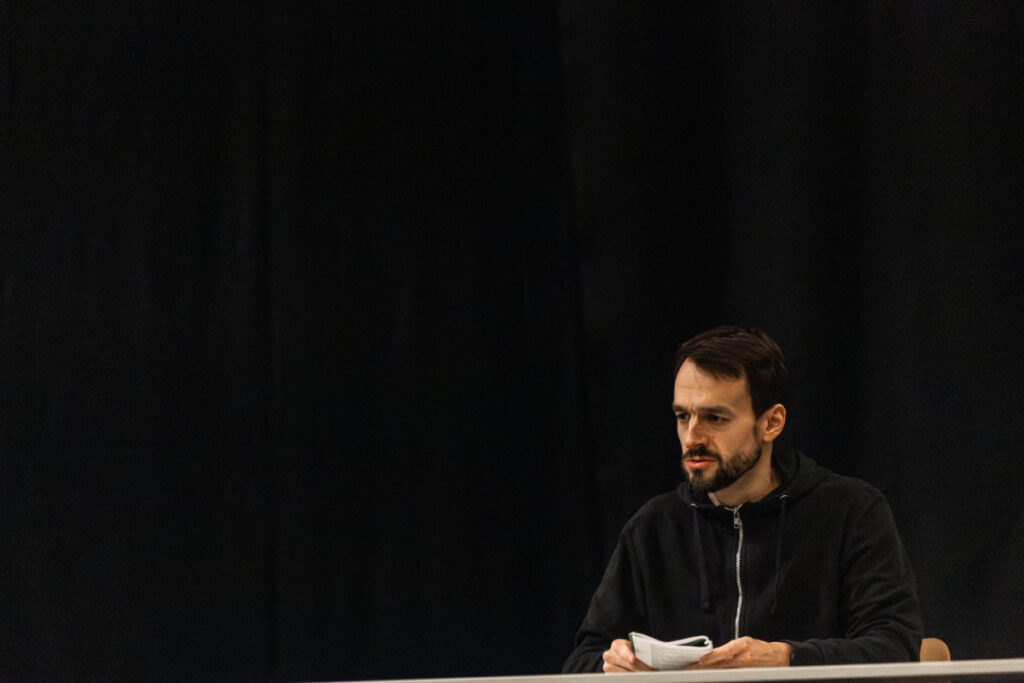
Photo (c) Sarah Naumann
Schreibe einen Kommentar