
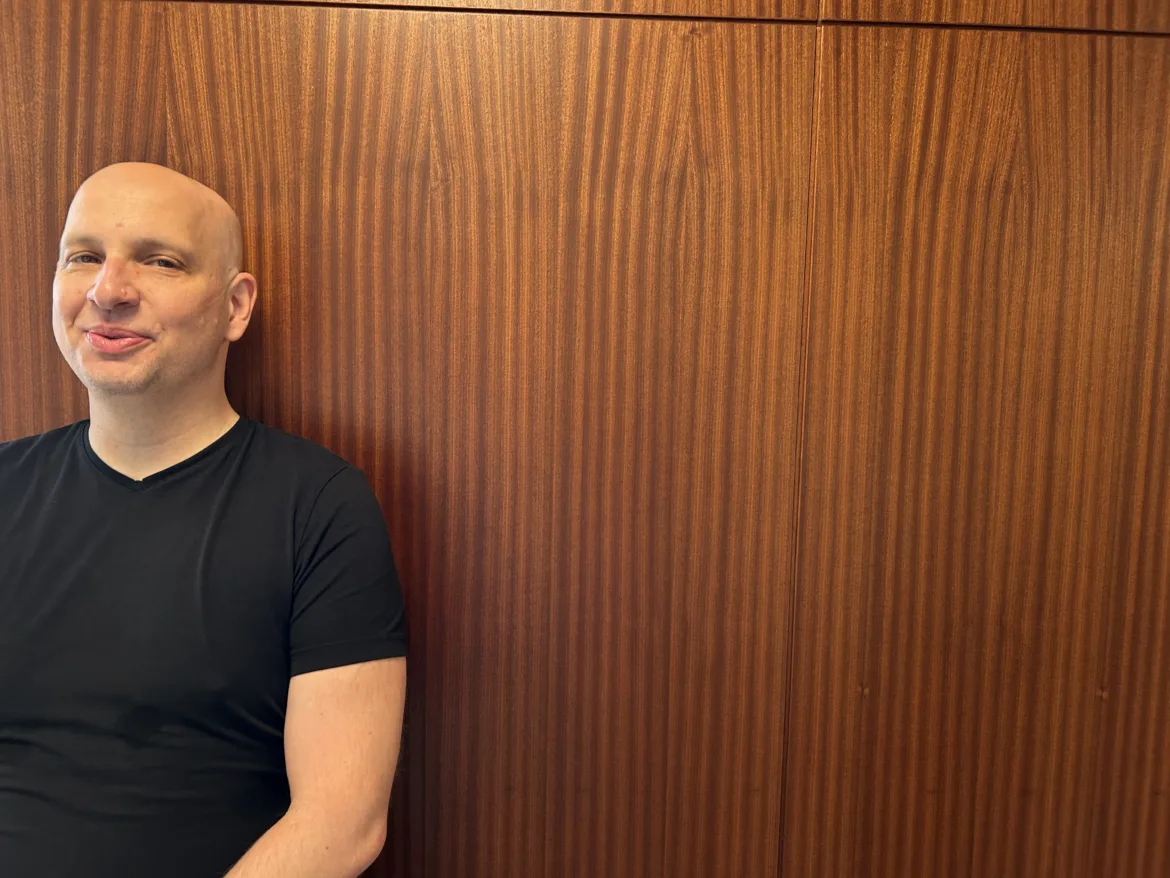
Jasper Koch interviewed by Michel Büch
Hi Jasper! You have often said that this play has stayed with you for several years and that you keep returning to it, rereading it from time to time. Do you remember your first encounter with it? What is it about the play that draws you in so strongly?
Jasper Koch | Unfortunately, I don’t remember how exactly I came across That Face. I suspect it was recommended to me. I was immediately gripped by the first scene and its intense, yet casual portrayal of bullying and the teenage experience. Although my teenage years are well and truly behind me, the central relationship between the siblings Mia and Henry felt viscerally authentic. Their mother Martha is also fascinatingly complex, and figuring out these sorts of characters is my favourite thing when it comes to directing.
The play presents the audience with a highly fragile social structure that resembles a family only in name. How do you intend to stage this aesthetically, beyond the narrative itself?
There are some plans for creating a set that reflects the instabilities of the relationship dynamic, probably using moveable, shifting, possibly unstable platforms on the stage. These plans are still uncertain and may change from the time this interview is conducted to the premiere. You’ll have to come and see for yourself.
We have spent significant time on making sure that the actors feel comfortable.
Jasper Koch
The auditions ended just three weeks ago, and you are now in the early stages of the rehearsal process. How do you generally begin rehearsals, and are there any specific challenges in working on this particular play?
After the read-through I always get together with the actors individually, so we can get to know each other and discuss both the play in general and their character in particular. In past productions, I’ve found these meetings extremely helpful in order to build a foundation of familiarity before jumping into rehearsing the scenes themselves. Trust is an absolutely essential part of any rehearsal process, especially when it comes to a play like That Face, which deals with intense emotional themes. Already during auditions, I tried to communicate the nature of these themes, so that everyone knew what they were getting themselves into. This has continued into rehearsals. We have spent significant time on making sure that the actors feel comfortable when exploring challenging themes without feeling pressured or overwhelmed.
That Face was first performed in 2007 at the Royal Court Theatre, which had played an instrumental role in the in-yer-face movement in British theatre roughly a decade earlier. How do you see That Face within the trajectory of in-yer-face aesthetics, if at all? In what ways does it differ from that tradition? Does it „take the audience by the scruff of the neck and shake it until it gets the message,“ as Aleks Sierz sweepingly describes in-yer-face theatre—and if so, what would that message be?

While That Face came a few years after the in-yer-face movement, I would argue that it clearly bears the mark of those plays, both in its subject matter and in how it shows the characters and their dynamics. It is, however, much less reliant on shock value and extreme violence than the plays of Sarah Kane, Philip Ridley or Mark Ravenhill. In its sharp dissection of dysfunctional relationships, it is closer to Patrick Marber and his seminal relationship play Closer. It also shares a strong sense of very dry humour with that play. Considering the Aleks Sierz quote, it places That Face squarely in that mode of communicating with the audience, especially in the way situations escalate very quickly, allowing the audience little room to breathe. The message itself I can’t really comment on yet. That is something my actors and I are still working out and is shifting a little in every rehearsal.
Critics and audiences have often criticized in-yer-face plays for portraying only the worst of what people can do to each other. However, one could also argue dialectically that there is a deep-rooted and humanistic sense of hope underlying that aesthetic of transgression, violence and shock. How does That Face engage with this issue, and what is your personal perspective on it?
While in-yer-face theatre certainly deals with the darker side of human experience, I don’t agree that it is about the worst in people. To me, it’s no coincidence that this movement followed the end of Margaret Thatcher’s term as prime minister. In-yer-face theatre is a direct reaction to Thatcher’s infamous statement that “there is no such thing as society.” It is an attempt to make sense of an increasingly fragmented, highly individualised society through characters who are lost. The characters in That Face certainly are lost when it comes to responsibility: they struggle with it, run from it, take on too much of it. Their relationship to it (and each other) is deeply dysfunctional and yet it makes them engage with each other, even if it is in negative ways. Trying is the point and in that there is hope.
While in-yer-face theatre certainly deals with the darker side of human experience, I don’t agree that it is about the worst in people.
Jasper Koch
You are the longest-running active member of the University Players, having joined in 1998 acting in a production of The Merry Wives of Windsor and celebrating your 25th year of membership in 2024, when you staged Macbeth. How was the atmosphere different when you first started, and what still remains today that originally attracted you to the group in your twenties?
The atmosphere within the group to me is pretty similar, the UPs are still an open, welcoming group of like-minded people. I particularly love the fact that new people join every semester and keep the group evolving constantly. The circumstances at the university, however, make things harder than they used to be. The group enjoys fewer freedoms and the changing structure of the university makes it more difficult for students to find the time to participate in our productions.

Over the years, you have worked in almost every department, though you have been most active as an actor and director. Have you observed any changes in the choice of plays or in staging styles over time?
Over the years, the group has generally moved away from the classics. The frequency of Shakespeare productions has dropped (partly because we’ve done most of them). There’s also been greater emphasis on producing more plays by women writers. In terms of staging, these days the set design is often more abstract than it used to be when I started at the UPs. At the time, we spent a lot of time building realistic rooms on the stage, often into the small hours. I don’t really miss that, both aesthetically and for health reasons.
The UPs are my home.
Jasper Koch
What do the University Players mean to you beyond the artistic work itself? More broadly, how do they fit into your life?
The University Players are a constant source of excitement, joy, stress, creativity and love in my life. I have been a part of this group for more than half my life, and I have made lifelong friends here. The UPs are my home.
Thank you so much for taking the time to answer our questions!
Photo (c) University Players / Sarah Naumann