
ON THE ROMANTICIZATION OF THE MOTHER-SON BOND
By Lea Siegler
Family influencers have taken up space online since the early days of social media. From mom blogs to YouTube family vloggers, the public interest in the way other people raise their children has seldom wavered. In recent years, another facet of family-style content has emerged on TikTok: the ‘boy mom’ bubble.
As the name suggests, these types of short-form videos feature mothers showcasing the ways in which they raise their sons—often from a very intimate perspective. They include statements like, “When I think about my daughters getting married, I get excited … when I think about my son’s wedding I wanna cry,” or “I never knew motherly love until I had a son.” Captions such as “Practicing how to be a toxic mother-in-law, because my son is and always will be mine” are commonplace.
Captions such as “Practicing how to be a toxic mother-in-law, because my son is and always will be mine” are commonplace.
These examples reflect not only the overly affectionate relationships those mothers have to their sons, they also glorify masculinity while claiming that being a mother of girls means committing to a life of drama. Noticeably, very few ‘boy moms’ online show self-awareness concerning the public idealization of their sons. Blurring the line between parental and romantic affection even further, some content even features physical affection more reminiscent of romantic and sexual partnerships than parental love: mothers kissing their teenage sons on the mouth, moms letting their sons slap them on the butt while on camera.
Like most social media trends, there is an undeniable performative nature to the behaviour at hand, a central aim being the generation of online engagement. Yet, ‘boy mom’ content nonetheless raises fundamental questions about parenthood and the underlying cultural implications: Is the toxic boy mom a product of internalized misogyny? Have we, as a society, accepted the value of boys over girls to the point of transforming how parents display affection for their kids?
In Polly Stenham’s play That Face (2007) similar dynamics between a mother and a son can no longer be (mis)understood as just performative, merely for shock value or the sake of online engagement, but they become pathological within the play’s narrative.
Children of Jocasta mothers tend to take on the role of caretaker, provider, and even lover, filling the vacant role of the husband.
That Face is centred on an alcoholic mother, Martha, and her relationship with her children Mia and Henry. It focuses on Martha’s unnaturally intimate fixation on Henry and her mutual disdain for her daughter. Henry is parentified; he parents his troubled mother. In consequence, he is incapable of developing and defending his own needs, as his mother’s well-being stands above all.
The portrayal of mother-son relationships on social media and, respectively, of Martha and Henry’s dynamic is reminiscent of the ‘Jocasta complex,’ an emotional or even sexual fixation of a mother on her son that involves extreme overprotectiveness, emotional incest, and the treatment of the son as a surrogate spouse or romantic partner. Jocasta was originally a figure in the Greek myth of Oedipus, namely the protagonist’s biological mother, whom he unknowingly marries later in life.
As Matthew Besdine explains in “The Jocasta Complex, Mothering and Women Geniuses” (1971), children of Jocasta mothers tend to take on the role of caretaker, provider, and even lover, filling the vacant role of the husband. Undoubtedly, Henry does fulfil this role. Martha’s behaviour oscillates between categorizing Henry as a lover and, in contrast, clearly as her child. She, on the one hand, continues to call him either her “Russian soldier”, “soldier boy”, or her “baby boy.” On the other hand, similar to the ‘boy mom’ mothers, Martha spirals into a jealous breakdown at the thought of Henry having sex with another woman: “You’re not mine anymore, you’re hers.”
According to Besdine, the Jocasta-mother is usually a product of any combination of the following: “a sexless, loveless life, grieving or hungering for children, the loss of her husband.” (55). Martha’s husband, Hugh, may not be dead, but she has certainly felt his loss: Not only has he left her, but she and the children have been replaced with a new wife and family, only emphasizing Martha’s own loveless existence. Consequently, Martha turns to her son for affection, even taking to sleeping in his bed. Martha’s grief over the loss of her marriage forces Henry to drop out of school, stay home, and take care of his mother to try and manage her addiction and navigate her mental health crises.
A son is a poor substitute for a lover.
Their relationship is reminiscent of arguably one of the most prominent media portrayals of the toxic mother-son bond: Norman Bates and his mother in Alfred Hitchcock’s Psycho (1960). Both Norman and Henry have grown up under the weight of their mothers’ undivided attention. Consequently, neither was able to develop a ‘normal’ mother-son relationship—while Norman’s jealousy of his mother’s romantic partners eventually turns him into a murderer, Henry’s responsibility for his mother brings him to a breaking-point where he cannot imagine himself as a person separate from Martha: “Can’t leave me. Stay with me. Belong together. Here, we belong here … We fit together. Please, Mummy.” Psycho’s Norman Bates has realized something that Henry in That Face has not yet come to understand: “A son is a poor substitute for a lover.”
When explaining his role in Martha’s life to his father, Henry puts it as follows: “Daddy, you left me here all by myself. So, I did what I thought you should have done. Taken care of her.” (91). Consequently, there is no doubt about the shared blame to be put on Hugh, as well as Martha. It is a father’s responsibility to make sure his children are not forced to take on a role that he has left vacant.
In summary, both the ‘boy mom’ phenomenon and That Face reflect gendered value systems, psychological patterns of attachment and the blurring of relational boundaries. But while social media is, by nature, hyperbolic, That Face shows mother and son unironically collapsing all emotional boundaries. Of course, not every son of an overly indulgent mother turns into Norman Bates. However, That Face makes clear the destructive consequences of Henry’s relationship with his mother and lack of a father on children in general. While Mia suffers from the emotional absence of both her parents, Henry’s whole life is concentrated on the undivided attention of and towards his mother. In this sense,
the play can almost be read as a warning to the actual boy moms of not only TikTok, but the world, to not let parental affection evolve into a build-your-own-boyfriend fantasy–no matter the state of your own romantic life.
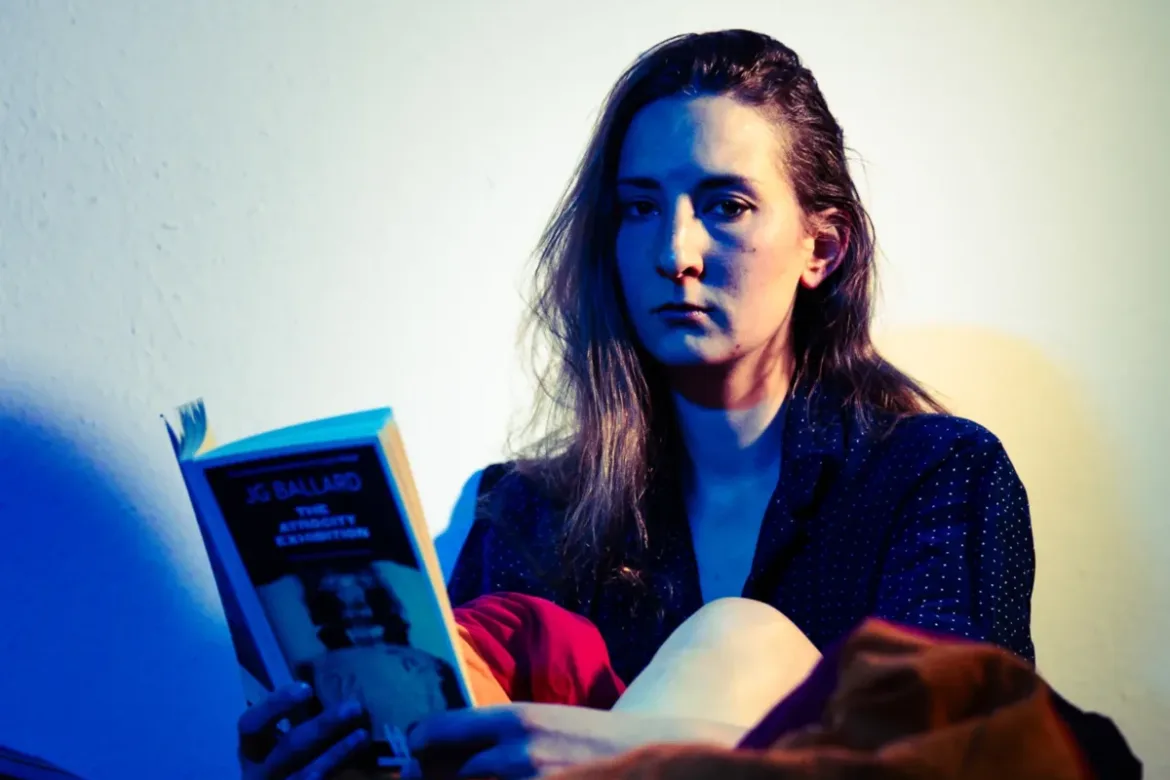
Photo (c) University Players / Sarah Naumann