
By Rafael Busse (BBS 1 Uelzen)
It was on the 19th of January 2026 that I saw the theatre play Dr. Jekyll and Mr. Hyde in the Audimax in Hamburg. While the play was based on the adaptation by Jeffrey Hatcher, the play itself was directed by Miriam Barbi. I was most interested in how this director/adaptation was going to handle the main themes of the novella. At the core of the original novella by R. L. Stevenson lies the concept of confronting the dark sides of the mind that slumber in every human being, while also showing the consequences of leaving that side unchecked.
To briefly summarise the plot of the adaptation: the play was about Dr. Henry Jekyll, who discovered a substance that, when ingested, forcibly draws out one’s dark side. So, Dr. Jekyll consumes the mixture multiple times throughout the play to turn into his supposedly evil alter ego Mr. Hyde. The play focuses on both Jekyll’s loss of control over his life, over Mr. Hyde, as well as Hyde’s humanity and growing resentment towards Dr. Jekyll. Important side characters include Utterson, a close friend of Jekyll, who throughout the story tries to help and understand Jekyll and his mysterious relationship to Mr. Hyde. Furthermore, there is also Elisabeth, a young woman who falls in love with Mr. Hyde, as well as Dr. Lanyon, Jekyll’s old colleague and friend and Sir Danvers Carew, a fellow doctor who doesn’t like Dr. Jekyll and vice versa. As already mentioned, Jekyll slowly starts to lose his grip on his sanity and autonomy while Utterson tries to help and understand his problem. A turning point occurs when Mr. Hyde one night kills Sir Danvers Carew, prompting Jekyll to try and suppress Hyde’s presence more aggressively. This of course, goes horribly wrong, with Hyde revolting, expressing his will to live. In the end Jekyll kills himself, leaving both Elisabeth and Utterson mourning.
Now to the actual performance. First, I think that all the actors did a phenomenal job portraying their respective roles. My favourite was without a doubt the actress playing Utterson, especially in her portrayal of the friendship to Dr. Jekyll. One could just feel their closeness and Utterson’s worry in every spoken line, as well as his devastation over Jekyll’s death. Other than that, their deep connection was noticeable by Utterson very early catching on that Jekyll is clearly troubled by something. Another aspect I found quite interesting was their different uses of their voice. While Sir Danvers Carew was always loud and condescending, Hyde was much more mischievous, and at times sounded evil to an almost comical extent and Jekyll was often charismatic, yet arrogant and as the play continued also increasingly unhinged and paranoid. Though there were also some downsides I felt. As much as I appreciated the character portrayals, some voices were at times just a little hard to understand, especially when there were other intended or unintended background noises. Nevertheless, the actors, all of them, were incredibly captivating to experience and I think that characters like Utterson, again, or Lanyon did a fantastic job also using different kinds of gesturing, with Lanyon for example doing more direct and pronounced movements appropriate to the role. (Side note: At this moment the names of the actors and crew members are not known to me, so, I will continue to refer to them by the name of their respective role.)
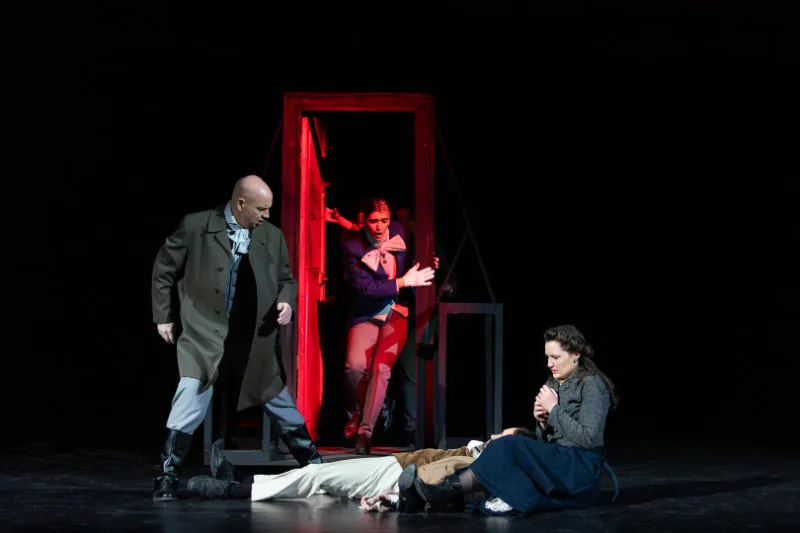
Of course, there are also other aspects to a theatre play such as the handling of various design elements on stage. There are quite a few things to unpack, so, let us start with the costumes and make up, which I think were again very appropriate. One could see the director was going for a more historically accurate design in that aspect, which I think served well to immerse me in the story, without alienating too greatly. Secondly, the stage design was simplistic, which helped the audience focus on more essential aspects of the play. I even think that a more complex/expensive set could have possibly been more of a detriment, since the simplicity also helped making the play more character driven, not letting the audience get distracted too much by superficial details and truly making us think about the roles presented. In terms of lighting, I think that again it was used quite well in showing the audience where to focus or to make the mood much darker with the sinister red light, where also some great sound design came into play to build up tension or show Jekyll’s inner mindscape through quiet whispering. I only wished that maybe they would have experimented with both the lighting but also the sound effects a little more, since they were used either rather sparingly or in the case of lighting the usage was not all that varied. Lastly, I found the choice of music when changing the scene to be quite interesting, yet unsure of its purpose. It was the same modern and sort of synthesized track that always played during these sections and I think that it may have contrasted a little too much with the Victorian/gothic aesthetic the play was going for in my opinion. Not to say I didn’t like the track itself but rather the implementation I found questionable, especially since it was always the same track.
To conclude, I just wanted to say that I really liked the idea of students performing the play, since you could just hear and see the passion behind it all, how the characters have been refined over course of the production and how much blood, sweat and tears it took to develop the entire show. The gripes I had with the play were comparatively minor, yet I think valid. Although I think my biggest gripe would be how at times (not always of course) parts of the audience made inappropriate or just loud remarks during the play, which made it even more admirable to see the actors continue their craft undeterred.
Photos by Sarah Naumann
Schreibe einen Kommentar