
By Sophia (BBS 1 Uelzen)
Can we truly separate good from evil, or are both forces inevitably part of the same person?
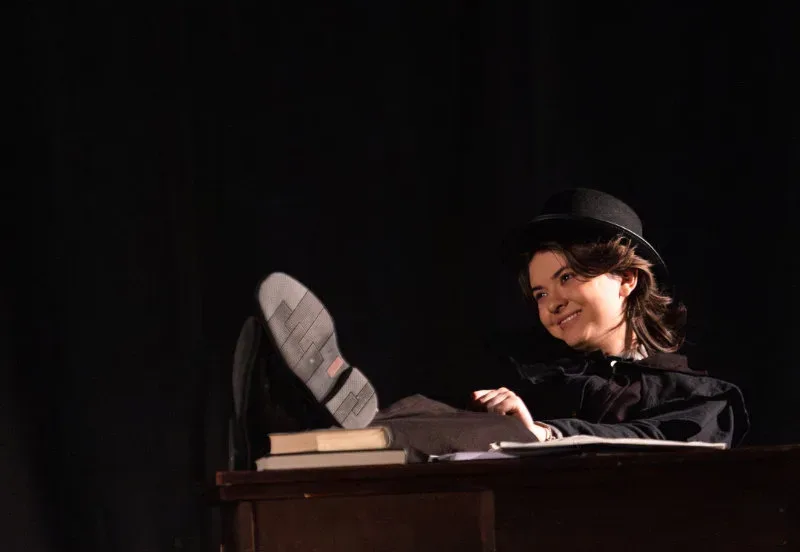
I saw the play at the largest lecture hall of the city, the Audimax (Auditorium Maximum) at the University of Hamburg, Von-Melle-Park 4. The performance took place on January 19, 2026, at 7:30 p.m. The title of the show was Dr. Jekyll and Mr. Hyde. It was originally written by Robert Louis Stevenson and adapted by Jeffrey Hatcher. The show was directed by Miriam Barbi. This production of the play questioned the clear separation between good and evil. It portrayed Dr. Jekyll not as a pure victim, but as someone who became addicted to his own experiments.
The play is set in the late nineteenth-century London, where a mysterious killer stalks the foggy streets. At the centre of the story is Dr. Henry Jekyll, a brilliant and respected scientist who becomes increasingly obsessed with separating the good and evil sides of human nature. Through his experiments, he creates his dark alter ego, Mr. Hyde. While Hyde gives him freedom to act without moral limits, he also commits violent crimes, including murder. As Jekyll lost control over his transformation, his addiction to the experiments grows stronger and ultimately leads to his downfall. Other important characters include members of London’s upper class and a chambermaid who becomes entangled in Jekyll’s dangerous double life.
An original score by Tobias Reinert added to the dark and intense atmosphere of the play. The staging emphasises psychological conflict, moral tension, and the destructive consequences of dual identity.
The performers deliver largely believable and realistic interpretations of their characters, especially in the demanding dual role of Dr. Henry Jekyll and Mr. Edward Hyde. The constant switching of roles between the actors made it difficult at the beginning and middle of the play to clearly identify who was portraying which character, which sometimes weakened the clarity of relationships between figures such as Gabriel John Utterson, Dr. Hastie Lanyon, and Mr. Poole. However, the actors consistently remained in character, particularly when portraying Mr. Hyde who was the most distinct and convincing figure on stage. His almost predatory and disturbing movements clearly set him apart from the other characters and made his presence immediately recognisable.
Vocal quality varied noticeably. Some actors projected their voices strongly and articulated clearly enough to be understood even in the back rows of the auditorium. Others were harder to understand, especially when turning away from the audience. In terms of physical performance, Hyde stood out again: his body language was tense, aggressive, and unsettling. Dr. Jekyll, particularly toward the end of the play, developed a paranoid posture and increasingly unstable gestures, which effectively reflected his psychological decline. The use of irony and sharp dialogue added moments of humour, keeping the audience engaged and occasionally provoking laughter. While the physical differentiation between minor character changes was sometimes unclear, the blocking overall made sense and supported the dramatic tension of the story.
The set design was minimal but effective. The main prop that remained on stage throughout the entire performance was the red door, which became a powerful symbol. It functioned as a front door, a room divider, and most importantly as a visual representation of the transition between Dr. Jekyll and Mr. Hyde. Because it never left the stage, it constantly reminded the audience of the thin boundary between the two identities. Other props, such as Dr. Jekyll’s desk and the examination table representing Hyde’s victims, looked realistic and well-made. They reinforced the late nineteenth-century London setting and supported the darker, almost grotesque atmosphere of the play. The lighting design played a crucial role in establishing mood. An intense red light, especially at the beginning and whenever Mr. Hyde appeared, created a strong sense of danger and violence. It clearly emphasised key moments, particularly Jekyll’s transformations and scenes of inner psychological conflict. The lighting successfully drew the audience’s focus to important actions and heightened dramatic tension. Costumes were appropriate to the historical period and helped distinguish social status and personality. Sound and music were also significant elements of the production. Transitional music accompanied scene changes and movement of stage elements like the door, making the shifts feel smooth rather than disruptive. Additionally, the music intensified crucial scenes, such as Jekyll’s transformation or moments when multiple “Hydes” represented his fractured mind. Together with the lighting, the sound design strengthened the emotional impact and deepened the psychological atmosphere of the play.
Overall, the production of Dr. Jekyll and Mr. Hyde was intense, thought-provoking, and visually striking. Despite minor weaknesses, such as occasional confusion caused by role switching and uneven vocal projection, the performance successfully captured the psychological depth and moral complexity of the story. The strong portrayal of Hyde, the symbolic use of the set, and the effective lighting and sound design created a dark and engaging atmosphere. This adaptation offered a modern and critical perspective on the duality of human nature and left a lasting impression on the audience.
In my opinion, the play was captivating and quite visually striking, with the lighting design playing a crucial role. Even if the props and background were limited, I still got pulled into the critical per5and complexity of the story.
Photos by Sarah Naumann
Schreibe einen Kommentar